Autonomous Vehicles: How Self-Driving Cars Work, When They Will Dominate the Market, and Why the Shift Is Inevitable
Autonomous Vehicles Explained: How Self-Driving Cars Function, When They Go Mainstream, and Why the Transition Is Unstoppable
Autonomous vehicles are no longer a futuristic fantasy reserved for science fiction movies or experimental tech demos. Over the last decade, Autonomous Cars have evolved quietly but consistently into one of the most disruptive forces in modern transportation. What once required human intuition, reflexes, and constant attention is increasingly being delegated to software, sensors, and artificial intelligence.
Today, Self-Driving Cars already operate in real-world environments through advanced driver-assistance systems, semi-autonomous highway driving, and controlled autonomous fleets. These systems are not isolated innovations; they represent a fundamental shift in how mobility is designed, regulated, and experienced. As automated vehicles mature, they are redefining the relationship between humans, machines, and the road itself.
Unlike traditional vehicles, Autonomous Cars rely on continuous data interpretation rather than human judgment. Cameras, radar, LiDAR, and onboard AI work together to create a real-time understanding of traffic, infrastructure, and unpredictable human behavior. This allows self-driving cars to make thousands of micro-decisions per second—adjusting speed, positioning, and trajectory with a level of consistency that human drivers cannot sustain.
The growing presence of automated vehicles signals more than a technological upgrade; it marks the beginning of a structural transition in global mobility. Cities, logistics networks, and transportation policies are already adapting to a future where autonomous vehicles are not an exception, but a core layer of everyday movement. This transition is gradual, but its momentum is increasingly difficult to ignore.
In this article, we break down what autonomous vehicles truly are beyond marketing buzzwords, how self-driving systems function behind the scenes, when automated vehicles are expected to reach mainstream adoption, and why their long-term impact will extend far beyond the automotive industry—reshaping safety standards, urban planning, and the economics of transportation itself.
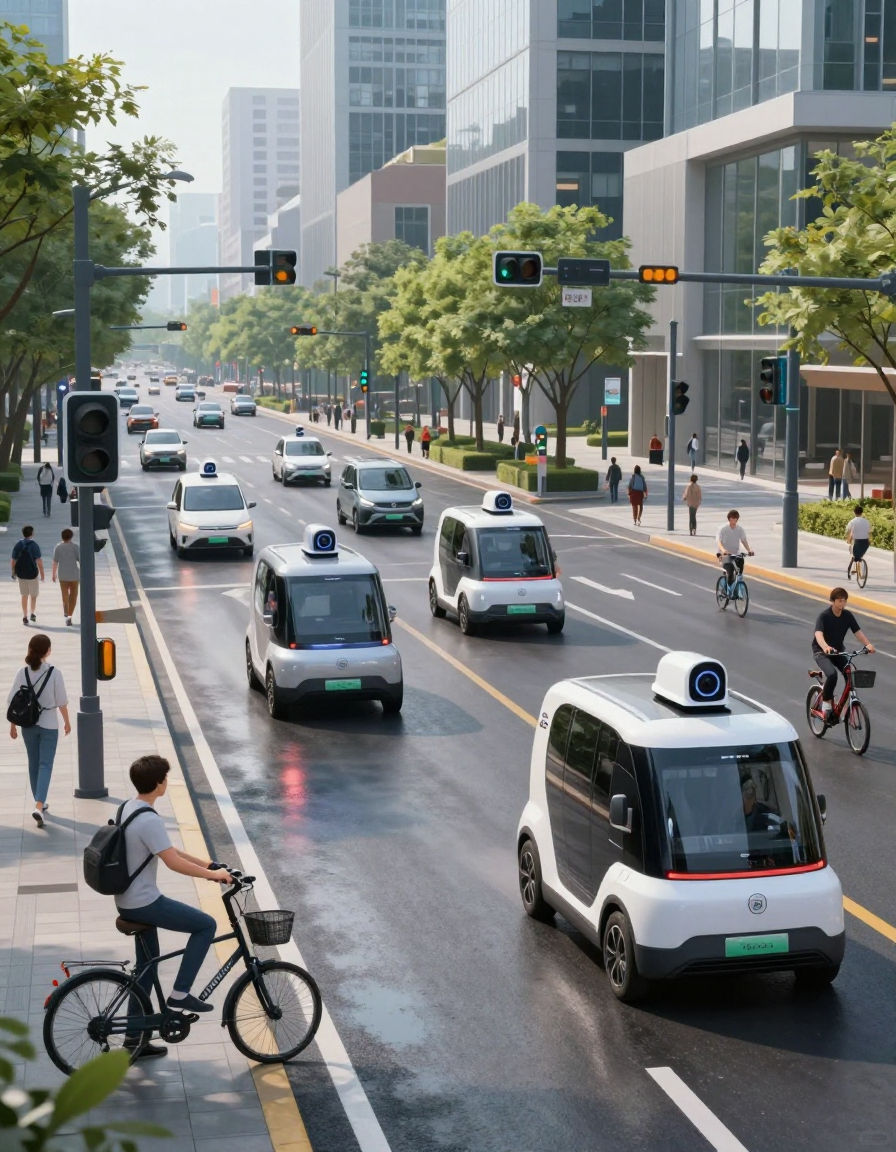
Autonomous Vehicles rely on advanced sensors, AI, and connectivity to operate safely.
These tools help enthusiasts, developers, and urban planners analyze, simulate, and optimize self-driving technology and its integration into real-world mobility.
- Advanced Digital Speedometer — simulate and monitor speed metrics in autonomous vehicle testing scenarios.
- Advanced E-Bike Simulator — practice urban navigation concepts relevant for autonomous fleet integration.
- AI Ride Analyzer — analyze driving patterns, predict AI behavior, and study traffic flow in autonomous systems.
- Compass — plan routes and orientation for autonomous navigation and mapping simulations.
- Battery Pack Builder — understand energy management critical for electric autonomous vehicles.
- Electric Bike Range Calculator — estimate power consumption for EV and autonomous micro-mobility integration.
- Content Readability Checker — optimize technical documentation and AI interface content for autonomous vehicle manuals.
Read More!
What Are Autonomous Vehicles?
Self-Driving Cars are intelligent transportation systems designed to navigate real-world environments with minimal or no human intervention. Often referred to as autonomous cars, these vehicles combine advanced sensing technologies, artificial intelligence, and high-speed data processing to perceive their surroundings, interpret complex situations, and execute driving decisions in real time. Unlike conventional vehicles that depend entirely on human awareness and reaction, automated vehicles are built to operate continuously, consistently, and without fatigue.
At their core, self-driving cars function as mobile computing platforms. They collect vast amounts of data from cameras, radar, LiDAR, GPS, and onboard sensors, transforming raw inputs into a dynamic understanding of traffic conditions, road geometry, obstacles, and human behavior. This continuous perception allows autonomous vehicles to anticipate events, predict movement patterns, and respond to changing conditions with a level of precision that exceeds traditional driver-controlled systems.
The development of automated vehicles is commonly defined through the SAE (Society of Automotive Engineers) levels of automation, which range from Level 0, where the human driver performs all driving tasks, to Level 5, where self-driving cars are capable of full autonomy in all environments and weather conditions without any human involvement. Most vehicles currently available to consumers operate at Level 1 or Level 2, offering features such as adaptive cruise control or lane-keeping assistance.
However, the true transformation begins at Level 4 and Level 5. At these stages, autonomous vehicles are no longer driver-assistance tools but independent mobility systems. Level 4 self-driving cars can already operate in restricted areas such as urban centers, highways, or logistics routes, while Level 5 represents the long-term vision of fully automated vehicles capable of replacing human drivers entirely.
Understanding what autonomous cars truly are requires moving beyond the idea of a “car that drives itself.” Self-driving cars represent a shift toward software-defined mobility, where transportation becomes safer, more efficient, and increasingly integrated into digital infrastructure. As this technology matures, automated vehicles are set to become a foundational component of future transportation ecosystems.
How Autonomous Vehicles Work: The Technology Stack
At the core of self-driving cars lies a layered and highly integrated technology stack designed to replace human perception, reasoning, and reaction. Autonomous cars do not “see” the road in a biological sense; instead, they construct a digital interpretation of reality using continuous data streams, probabilistic models, and real-time computation. Every driving action performed by automated vehicles is the result of multiple subsystems working in parallel within milliseconds.
Sensors and Perception
Autonomous cars rely on a diverse array of sensors to achieve reliable perception under varying conditions. High-resolution cameras provide visual context such as lane markings, traffic lights, road signs, and object classification. Radar systems excel at measuring distance and velocity, especially in rain, fog, or low-light environments where visual sensors struggle.
LiDAR plays a critical role in self-driving cars by generating highly accurate three-dimensional representations of the surrounding environment. By emitting laser pulses and measuring their reflections, LiDAR allows autonomous vehicles to understand depth, object contours, and spatial relationships with centimeter-level precision. Ultrasonic sensors complement this system by handling close-range detection during low-speed maneuvers such as parking or obstacle avoidance.
The perception layer of automated vehicles continuously fuses data from all sensors, cross-validating inputs to reduce uncertainty and minimize false detections. This sensor fusion is essential for achieving redundancy and safety in complex real-world scenarios.
Artificial Intelligence and Decision-Making
Once perception is established, autonomous cars rely on artificial intelligence to interpret the environment and determine appropriate actions. Machine learning models, trained on millions of real and simulated driving scenarios, enable self-driving cars to recognize patterns, predict motion trajectories, and assess risk in dynamic traffic situations.
These AI systems allow automated vehicles to anticipate the behavior of pedestrians, cyclists, and other vehicles rather than simply reacting to them. Decision-making engines evaluate multiple potential outcomes simultaneously, selecting the safest and most efficient maneuver—whether that involves braking, accelerating, changing lanes, or rerouting entirely.
Crucially, autonomous vehicles operate under strict safety constraints, prioritizing collision avoidance and compliance with traffic laws over speed or convenience. This rule-based oversight ensures that AI-driven decisions remain predictable and auditable.
HD Maps and Connectivity
Many self-driving cars enhance onboard perception with high-definition maps that provide detailed information about road geometry, lane boundaries, traffic signals, and static infrastructure. These HD maps allow autonomous cars to localize themselves with extreme accuracy, often within a few centimeters.
Connectivity further strengthens automated vehicles performance. Through cloud-based updates and vehicle-to-cloud communication, self-driving cars receive refreshed map data, software improvements, and insights derived from entire fleets. This collective learning approach enables autonomous vehicles to improve continuously, even when individual vehicles encounter new or rare driving scenarios.
Together, sensors, artificial intelligence, and connectivity form a resilient technological foundation that allows self-driving cars to function safely, adapt to change, and scale beyond controlled environments toward widespread real-world deployment.
When Will Autonomous Vehicles Reach Mass Adoption?
The path toward mass adoption of self-driving cars is shaped far more by social, regulatory, and infrastructural factors than by raw technological capability. From a purely technical perspective, autonomous cars at Level 4 autonomy are already operational today in controlled environments such as robotaxi services, autonomous delivery routes, ports, and logistics hubs. The technology exists, but large-scale deployment requires alignment beyond engineering.
Regulation remains one of the primary gatekeepers. Automated vehicles must operate within legal frameworks that vary significantly between countries and even between cities. Governments are gradually adapting traffic laws, liability models, and safety standards to accommodate autonomous cars, but this process is inherently cautious. Public trust follows regulation closely; widespread acceptance depends on consistent, transparent performance over millions of real-world miles.
Between 2026 and 2030, self-driving cars are expected to expand meaningfully across urban transportation ecosystems. During this phase, autonomous vehicles will most commonly appear as shared mobility solutions—robotaxis, autonomous shuttles, and commercial fleets—rather than privately owned cars. These use cases allow automated vehicles to operate within mapped areas, optimized routes, and centralized oversight, reducing risk while increasing efficiency.
Full consumer-level autonomy, where individuals own personal vehicles capable of operating autonomously in all conditions, is likely to emerge gradually rather than through a single disruptive moment. Self-driving cars will first offer expanded hands-free capabilities, followed by conditional autonomy in specific environments such as highways or urban centers. Over time, these features will evolve into fully autonomous cars systems as infrastructure and legal frameworks mature.
Rather than a sudden transportation revolution, automated vehicles will integrate into society through a phased transition. They will begin as specialized mobility services, evolve into optional autonomy features within conventional vehicles, and eventually become a default expectation for future transportation. This incremental adoption model reflects how transformative technologies historically gain trust, scale safely, and reshape everyday life.
Why Autonomous Vehicles Matter More Than You Think
The importance of self-driving cars extends far beyond comfort, convenience, or technological novelty. At a fundamental level, autonomous cars address one of the most persistent problems in modern society: human error in transportation. Distraction, fatigue, emotional stress, and impaired judgment contribute to the majority of road accidents worldwide. By removing these variables, automated vehicles introduce a level of consistency and attentiveness that human drivers cannot reliably maintain.
Self-driving cars are designed to operate without lapses in concentration. They do not text, rush, or misjudge distance due to stress or exhaustion. This continuous awareness enables autonomous vehicles to react faster to hazards, maintain safer following distances, and comply strictly with traffic laws. Over time, widespread adoption of autonomous cars has the potential to significantly reduce injuries, fatalities, and the broader social costs associated with traffic collisions.
Beyond safety, automated vehicles play a critical role in reshaping traffic efficiency. Through coordinated driving, predictive routing, and smoother acceleration patterns, self-driving cars can reduce stop-and-go congestion that wastes time and energy in urban environments. When vehicles communicate with each other and with infrastructure, traffic becomes a managed system rather than a collection of isolated human decisions.
The environmental impact of autonomous cars is equally significant. Optimized driving behavior reduces unnecessary braking and acceleration, lowering energy consumption regardless of powertrain type. When self-driving cars are paired with electric propulsion, their efficiency gains multiply, supporting cleaner air, quieter streets, and more sustainable urban planning. In this context, automated vehicles become an enabling technology for greener cities rather than a standalone innovation.
Perhaps most importantly, self-driving cars have the potential to expand mobility access. For elderly individuals, people with disabilities, and those unable to drive, autonomous vehicles offer independence without reliance on traditional transit systems. This social dimension elevates automated vehicles from a technological advancement to a meaningful infrastructure upgrade with long-term societal impact.
Autonomous Vehicles and the Future of Mobility
Self-driving cars will not replace traditional cars overnight, but they are set to fundamentally redefine how mobility is accessed, owned, and managed. Instead of every individual owning a personal vehicle, autonomous cars enable a shift toward usage-based transportation models, where mobility becomes a service rather than a possession. In dense urban environments, automated vehicles fleets have the potential to reduce the number of cars on the road while increasing overall transportation availability.
As self-driving cars mature, the concept of car ownership itself may evolve. Shared autonomous vehicles can operate nearly around the clock, dramatically increasing utilization rates compared to privately owned cars that remain parked most of the day. This efficiency allows cities to reclaim space currently dedicated to parking, opening opportunities for greener public areas, bike infrastructure, and pedestrian-friendly design.
The future of mobility is not centered on automated vehicles alone, but on how they integrate with other transportation modes. Autonomous cars are expected to coexist seamlessly with e-bikes, electric scooters, and public transit, acting as connectors rather than replacements. In this integrated ecosystem, self-driving cars may handle longer or complex routes, while micromobility solutions serve short-distance, last-mile travel.
This convergence aligns with broader trends in smart cities, electric transportation, and data-driven urban planning. Automated vehicles can synchronize with traffic systems, charging infrastructure, and public transportation schedules, creating a more responsive and adaptive mobility network. Platforms focused on intelligent mobility, such as RideWattly, sit at the intersection of these developments, where self-driving cars, electric mobility, and user-centric transportation choices converge.
Ultimately, autonomous vehicles represent a transition toward mobility systems designed around efficiency, accessibility, and sustainability rather than individual vehicle ownership. As cities and technologies evolve together, self-driving cars will become a foundational layer in a future where movement is smarter, cleaner, and more interconnected than ever before.
Key Challenges Facing Autonomous Vehicles
Despite rapid technological progress, self-driving cars continue to face a set of complex challenges that extend beyond engineering. While sensors, artificial intelligence, and computing power improve year after year, autonomous cars must operate in an open, unpredictable world shaped by human behavior, legal systems, and social expectations. These factors introduce layers of complexity that cannot be solved by technology alone.
One of the most debated challenges surrounding automated vehicles is ethical decision-making. In rare but critical situations, self-driving cars must evaluate risk, prioritize safety, and choose between imperfect outcomes. Translating human moral judgment into transparent, consistent decision frameworks remains an ongoing area of research and public discussion.
Cybersecurity is another significant concern. As autonomous cars become increasingly connected, they also become potential targets for digital attacks. Protecting automated vehicles from unauthorized access, data manipulation, or system interference is essential to ensuring public safety and maintaining trust in autonomous mobility systems.
Self-driving cars also struggle with so-called edge cases—unusual, rare, or highly complex scenarios that fall outside typical training data. Construction zones, unexpected pedestrian behavior, extreme weather, and inconsistent road markings challenge even the most advanced automated vehicles. Addressing these scenarios requires massive data collection, simulation, and continuous real-world validation.
Regulatory fragmentation further complicates adoption. Autonomous cars must comply with different legal frameworks across regions, covering liability, insurance, and operational responsibility. The lack of unified standards slows deployment and increases uncertainty for manufacturers, cities, and consumers alike.
Public perception ultimately ties all these challenges together. Trust in self-driving cars is built gradually through proven safety records, transparency, and real-world reliability. History suggests that transformative technologies often face skepticism before becoming mainstream, and automated vehicles are following a similar trajectory toward acceptance through demonstrated value rather than promises alone.
Suggested topics:
🎥 Watch: How self-driving cars work — this animated video explains the key technologies behind autonomous cars, including sensors, AI, and perception, so you can understand how automated vehicles navigate the world.
Conclusion: Are Autonomous Vehicles Inevitable?
The short answer is yes—but not because technology alone is pushing society in that direction. Self-driving cars are inevitable because they address fundamental challenges that modern transportation systems can no longer ignore. Road safety, urban congestion, environmental sustainability, and accessibility are systemic issues, and autonomous vehicles offer scalable solutions where incremental improvements fall short.
Automated vehicles promise safer roads by reducing the impact of human error, smarter cities through optimized traffic flow, and more inclusive mobility for people who are currently underserved by traditional transportation models. For aging populations, individuals with disabilities, and communities with limited transit access, self-driving cars represent not just convenience, but independence and opportunity.
That said, full autonomy will not arrive overnight. The global transition toward autonomous cars will be gradual, shaped by regulation, infrastructure readiness, and public trust. Partial autonomy, shared autonomous services, and controlled deployments will continue to pave the way forward. What matters most is not speed alone, but responsibility—ensuring that automated vehicles are introduced in a way that prioritizes safety, transparency, and societal benefit.
The broader direction, however, is unmistakable. Self-driving cars are no longer an experimental concept or a distant vision. They are steadily becoming a foundational layer of future mobility systems, working alongside electric vehicles, micromobility solutions, and smart urban infrastructure. The question is no longer whether autonomous cars will become part of everyday life, but how intelligently they will be integrated into it.
For readers seeking ongoing insights into future mobility, electric transportation, and intelligent vehicle ecosystems, platforms like RideWattly are uniquely positioned at the intersection of innovation and real-world impact—where emerging technologies such as self-driving cars meet practical, data-driven mobility decisions.
Further reading:
SAE Levels of Driving Automation
Waymo Autonomous Driving Technology
Tesla Autopilot & Full Self-Driving
❓ Frequently Asked Questions (FAQ) about Autonomous Vehicles
What are autonomous vehicles?
How do autonomous vehicles work?
When will autonomous vehicles become mainstream?
What are the main benefits of autonomous vehicles?
What are the challenges facing autonomous vehicles?
How do autonomous vehicles handle safety?
Will autonomous vehicles replace personal car ownership?
How do autonomous vehicles impact smart cities?
Are autonomous vehicles environmentally friendly?
What is the future outlook for autonomous vehicles?