Guide to Controllers and Features: 7 Proven Ways to Unleash Your E-Bike’s Full Potential
⚡ Complete Guide to Controllers and Features for E-Bikes
This in-depth guide to controllers and features is designed to give e-bike riders, enthusiasts, and builders a complete understanding of how the electronic control system defines performance, responsiveness, and safety.
The e-bike controller acts as the intelligent heart of your electric bicycle — interpreting your actions, managing energy flow, and ensuring a smooth connection between your battery, motor, and sensors.
Within this guide to controllers and features, you’ll learn how these compact yet powerful devices transform electricity into motion through precise control algorithms and advanced electronics.
We’ll explore what makes different controller types — from basic square-wave designs to advanced field-oriented (FOC) systems — behave differently on the road, and how these differences affect acceleration, noise, and energy use.
Choosing the right controller isn’t just about power — it’s about optimizing your riding experience.
A properly matched controller ensures your motor receives the right amount of current for your riding style, whether that means smooth, gradual acceleration for city cruising or instant torque for steep climbs and performance builds.
By understanding the principles behind voltage, current, and motor compatibility, this guide to controllers and features will help you make confident decisions before upgrading or building your next e-bike.
As technology continues to evolve, modern controllers also integrate smart sensors, regenerative braking systems, Bluetooth connectivity, and diagnostic feedback — features once reserved for high-end e-bikes.
This guide to controllers and features will walk you through how these innovations improve efficiency, battery lifespan, and overall control precision, so you can get the most out of your electric ride.
Read More!
🔧 How an E-Bike Controller Works
Understanding how an e-bike controller works is a key part of any guide to controllers and features.
The controller acts as the intelligent intermediary between your input and the motor’s mechanical output.
When you twist the throttle or start pedaling, the controller interprets those signals using built-in sensors and algorithms, determining exactly how much electrical current should be delivered to the motor in real time.
At its core, the controller regulates the conversion of direct current (DC) from your battery into alternating current (AC) pulses that drive the motor’s coils.
These pulses are carefully timed using pulse-width modulation (PWM) — a technique that allows smooth, precise control of speed and torque.
By analyzing constant feedback from the motor’s hall sensors, temperature probes, and voltage meters, the controller maintains stability and ensures optimal energy efficiency.
A sophisticated e-bike controller doesn’t just transmit power; it interprets context.
For example, when climbing a hill, the system can automatically increase torque while limiting current draw to prevent overheating.
When braking, regenerative systems can redirect energy back into the battery, improving range and sustainability — a concept often discussed in this guide to controllers and features as one of the hallmarks of smart e-mobility engineering.
Communication between the controller and other e-bike components is also evolving.
Advanced models use CAN-bus or UART communication protocols to exchange data with displays, sensors, and even smartphone apps.
This enables real-time diagnostics, ride customization, and firmware updates — transforming the controller into a connected brain that learns and adapts over time.
In this guide to controllers and features, these smart interactions represent the future of efficient, data-driven e-bike control systems.
Finally, a well-engineered controller ensures both performance and protection.
Built-in safety layers such as over-current limits, short-circuit detection, low-voltage cut-offs, and thermal management prevent damage to sensitive electronic parts.
This combination of intelligence, responsiveness, and durability defines the controller as one of the most critical components in any e-bike setup — a recurring theme throughout this guide to controllers and features.
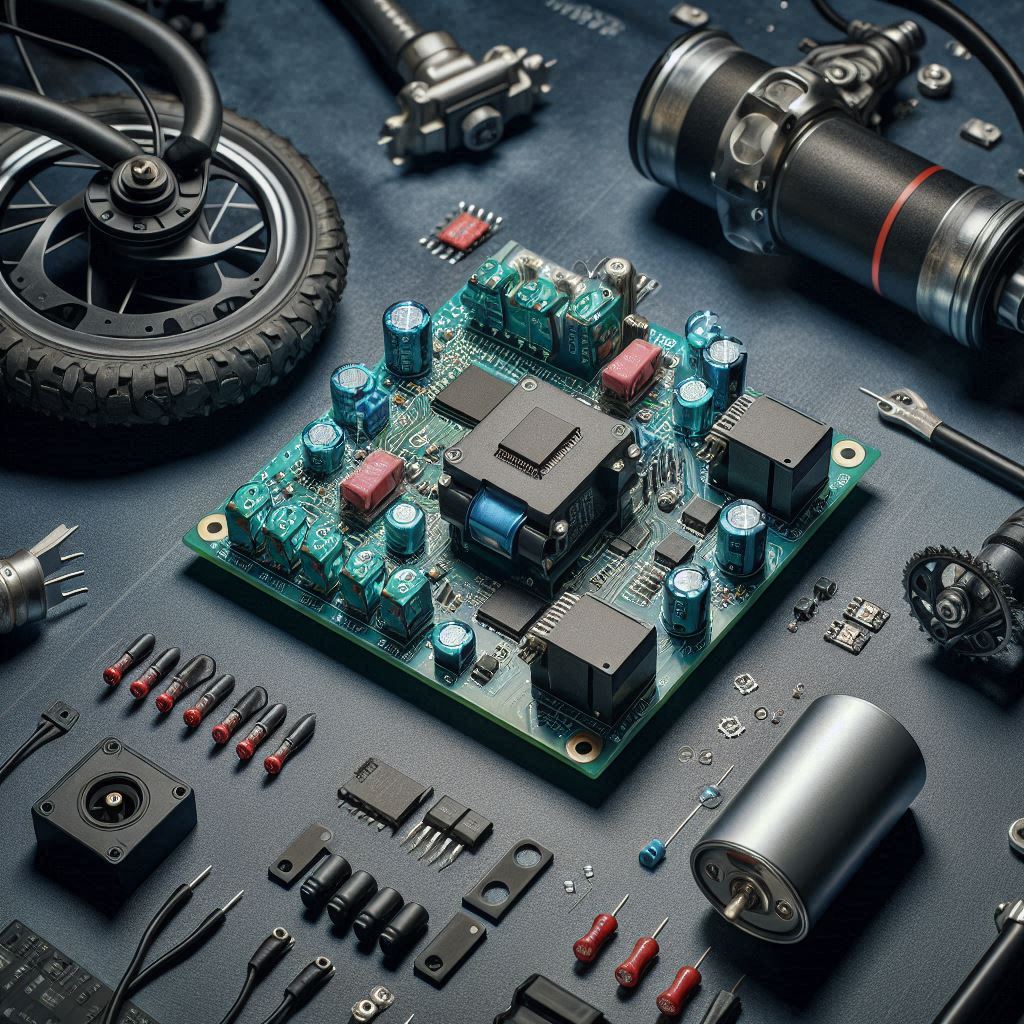
🧩 Internal Components Explained
To fully grasp this guide to controllers and features, it’s essential to understand what’s happening inside the e-bike controller.
Beneath its compact aluminum housing lies a carefully engineered electronic system that translates user intent into precise electrical control.
Each component inside plays a specific role — from data processing to thermal regulation — ensuring that your e-bike responds smoothly, efficiently, and safely to every command.
A high-quality controller is built around a combination of digital intelligence and electrical power-handling capability.
The microcontroller (MCU) is the core processor — essentially the “brain” — that interprets throttle signals, pedal-assist sensor data, and other feedback from the motor or battery.
It executes algorithms that determine the motor’s behavior, speed modulation, and torque delivery.
In advanced models, the MCU also supports field-oriented control (FOC), optimizing current flow to achieve smoother acceleration and higher efficiency — a key concept in this guide to controllers and features.
Surrounding the MCU are the MOSFETs — powerful transistors responsible for switching current on and off at extremely high frequencies.
They act as the muscles of the system, channeling large amounts of energy from the battery to the motor while maintaining efficiency and minimizing heat loss.
MOSFET quality and configuration (often 6, 9, or 12 units) directly affect how much current the controller can safely handle.
This guide to controllers and features emphasizes that premium controllers use low-resistance MOSFETs for reduced heat and greater performance stability.
Another essential element inside every controller is the voltage regulator.
This circuit ensures that the microcontroller and signal-processing chips receive a stable voltage supply, even when battery levels fluctuate.
Without a proper regulator, sudden drops or surges could cause erratic performance or even permanent damage to the electronics.
As this guide to controllers and features explains, voltage stability is one of the foundations of consistent e-bike behavior.
Next are the capacitors, which act like short-term energy reservoirs.
They store and release small amounts of charge to smooth out voltage spikes that occur when accelerating or braking suddenly.
This prevents electrical noise and helps maintain clean, uninterrupted communication between components.
Large, high-quality capacitors also play a critical role in extending the controller’s lifespan — another point highlighted throughout this guide to controllers and features.
Finally, all this electrical activity generates heat, which must be carefully managed.
The heat sink — usually made of aluminum or copper — disperses excess heat away from the MOSFETs and other components.
Some advanced controllers include built-in thermal sensors that monitor temperature in real time, automatically reducing output if overheating is detected.
Effective heat management is vital for long-term reliability, especially in high-power or off-road e-bike systems discussed in this guide to controllers and features.
Together, these components form a tightly integrated system that balances intelligence, power, and protection.
Understanding how each part contributes to the overall function gives riders and builders the knowledge to choose controllers that match their performance needs and durability expectations — the central goal of this comprehensive guide to controllers and features.
🔍 Types of E-Bike Controllers
Understanding the different types of e-bike controllers is one of the most important sections in any guide to controllers and features.
The controller is the “brain” of your e-bike, managing how power flows from the battery to the motor. Choosing the right controller affects acceleration, motor noise, energy efficiency, and even how natural your ride feels.
| Type | Best Use | Key Features |
|---|---|---|
| Sine Wave Controller | Urban riders seeking comfort, quiet operation, and smooth power delivery | Generates a smooth sinusoidal current for the motor, resulting in silent performance, precise throttle response, and improved energy efficiency. Ideal for commuters who value a natural and refined riding experience. |
| Square Wave Controller | Budget-friendly DIY builds or basic conversion kits | Produces a simple square electrical signal, offering direct torque and solid reliability at a lower cost. While it’s less smooth and slightly noisier, it’s often chosen for affordability and ease of setup for beginners or hobbyists. |
| FOC (Field Oriented Control) | Performance riders, e-cargo, and smart e-bike systems | Uses sensor feedback and advanced algorithms to dynamically adjust motor torque and phase current. The result is ultra-smooth acceleration, precise control at all speeds, and enhanced thermal efficiency. FOC controllers are the premium choice for high-end e-bikes and intelligent systems that aim to deliver a seamless and powerful riding experience. |
As highlighted in this guide to controllers and features, there’s no one-size-fits-all solution — the right choice depends on your riding goals, motor type, and budget.
From the quiet sophistication of sine wave designs to the raw simplicity of square wave units and the intelligence of FOC systems,
understanding these differences ensures your e-bike runs at its best potential.
⚙️ Key Specifications to Compare
When selecting the right e-bike controller, understanding key specifications is essential for performance, safety, and system longevity.
In this guide to controllers and features, we’ll break down the core specs that define how efficiently your controller communicates with your motor, battery, and sensors.
These details determine everything from your acceleration curve to battery lifespan and ride smoothness.
- Voltage Compatibility: The first rule in matching components is voltage alignment.
Your controller must be rated for the same voltage as your battery — whether 36V, 48V, 52V, 60V, or 72V.
Using a mismatched controller can cause poor performance, overheating, or even component failure.
Higher voltage systems generally allow for better top speed and efficiency, but require a controller built to handle the extra current. - Current Limit (Amps): The amp rating dictates how much electrical current flows from the battery to the motor.
Higher current means stronger torque and faster acceleration, but also more stress on the motor and battery.
In this guide to controllers and features, it’s recommended to balance your desired performance with safe current limits
— for example, 25A for moderate commuting setups and up to 40A or more for high-power builds. - Motor Type Compatibility: Controllers are designed for specific motor types —
either hub motors (common in most commuter bikes) or mid-drive motors (for torque-oriented performance).
You must also match the motor’s internal design — brushed or brushless.
Modern brushless (BLDC) motors require more advanced controllers capable of handling multiple phases and Hall sensor feedback for smooth power modulation. - Waterproof Rating: A high-quality controller should offer reliable protection against dust and moisture.
Look for a rating of IP65 or higher if you plan to ride in all weather conditions.
Proper sealing not only extends the controller’s lifespan but also ensures consistent performance when exposed to rain, puddles, or humidity. - Throttle & PAS (Pedal Assist) Support: Not all controllers handle input systems the same way.
If you prefer throttle-only control, make sure your unit supports analog throttle input.
For pedal-assist users, confirm that the controller recognizes PAS sensors and can modulate assistance levels smoothly.
The best controllers — especially those highlighted in this guide to controllers and features —
allow seamless switching between both modes, providing flexibility for different riding conditions.
In summary, comparing these specifications ensures that your controller and e-bike components work in harmony.
Voltage defines system range, current defines power, and compatibility defines reliability.
By carefully evaluating each of these key specs, you can optimize your ride for performance, comfort, and long-term efficiency —
the true goal of this comprehensive guide to controllers and features.
Suggested topics:
10 Mistakes to Avoid When Buying electric bikes
Complete U.S. E-Bike Laws Guide
E-Bikes and Batteries Recycling
AI and Smart Sensors
Smart Urban Riding Etiquette
🎥 Watch: Dive into the workings of an e‑bike controller — what it does, how it works, and which features matter most when choosing one.
💡 Summary & Recommendations
After exploring this comprehensive guide to controllers and features, one key insight stands out —
the controller is the true command center of your e-bike. It determines how efficiently power flows from your battery to the motor,
how smoothly your bike accelerates, and how safely your system responds under pressure.
Choosing the right controller can completely transform the way your electric bike feels and performs.
For urban commuters who value silence, comfort, and reliability, a sine wave controller remains the gold standard.
It offers whisper-quiet operation, refined acceleration, and excellent energy efficiency — perfect for daily rides in the city.
Riders seeking high-performance or heavy-duty power delivery, such as cargo or off-road builds,
should consider an FOC (Field Oriented Control) controller. These advanced systems use precise torque and speed algorithms
to provide smoother handling, better thermal performance, and adaptive feedback based on rider input.
Before upgrading, revisit the main specifications discussed throughout this guide to controllers and features:
voltage compatibility, current limits, waterproof rating, and motor matching.
A mismatch in any of these can lead to inefficient energy use, reduced battery life, or overheating.
On the other hand, a properly tuned controller can unlock hidden potential —
improving torque response, extending battery lifespan, and delivering a more natural and intuitive riding experience.
Investing in a modern, smart controller is one of the simplest yet most effective upgrades you can make to your e-bike.
Many of today’s models come with Bluetooth connectivity, regenerative braking options, and real-time diagnostics via mobile apps —
features that bring precision control and insight once reserved for high-end systems.
By understanding and applying the principles from this guide to controllers and features,
you can confidently select a controller that aligns with your riding style, performance goals, and technical setup.
In short, a well-matched controller bridges the gap between raw electrical power and refined mechanical performance.
It’s not just a component — it’s the heartbeat of your e-bike.
Whether you’re building a custom project or optimizing a daily commuter,
taking the time to choose wisely will reward you with smoother rides, longer battery life, and greater riding satisfaction.
🚀 7 Proven Ways to Unleash Your E-Bike’s Full Potential
- Choose the right controller type (Sine Wave or FOC) for your riding style.
- Match controller voltage with your battery for optimal performance.
- Ensure current limits are appropriate to balance acceleration and battery life.
- Confirm motor compatibility (hub vs. mid-drive, brushed vs. brushless).
- Upgrade to smart controllers with torque control and adaptive feedback.
- Check waterproof rating and protection features for all-weather reliability.
- Regularly maintain and tune your controller and sensors for consistent smooth power delivery.
Following these 7 proven strategies ensures your e‑bike delivers maximum efficiency, smoothness, and safety, making every ride more enjoyable and powerful.
❓ Frequently Asked Questions (FAQ) about E-Bike Controllers and Features
What does an e-bike controller actually do?
Which controller type is best for a smooth ride?
What is the difference between sine wave and square wave controllers?
What does FOC mean in e-bike controllers?
How do I choose the right controller voltage?
Does a higher current limit make my e-bike faster?
What are the safety features of modern e-bike controllers?
Can I upgrade my existing controller to improve performance?
Are e-bike controllers waterproof?
What is the best controller for cargo or performance e-bikes?








VVwin, pretty standard online gaming site. I’ve had some lucky streaks there. Their site: vvwin
Can you be more specific about the content of your article? After reading it, I still have some doubts. Hope you can help me.